
Co-Creation and creative & playful methods
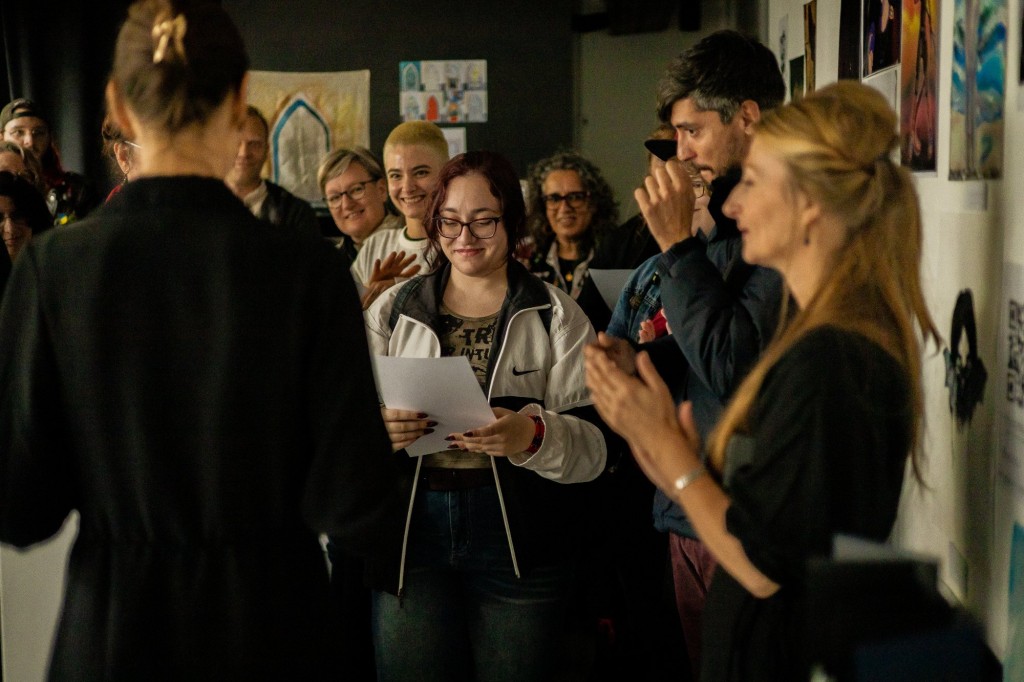
Author: Kristína Bogárová, Youth for Equality
Original published article on TRNAVSKÝ HLAS
Collection of methods and materials
- Co-creativity
- Methods from artists
- Playful methods
- Creative methods
Professional Media Presence (PMP) is a Creative Europe project that brings together artists and cultural professionals across Europe to explore how media shapes artistic identity, inclusion, and communication. Through workshops, residencies, and creative collaborations, PMP helps artists strengthen their digital presence and co-create new practices for professional growth. Guided by the From Artists-To-Artists Approach, the activities emphasize peer learning, mentoring, and reflection through play and experimentation.
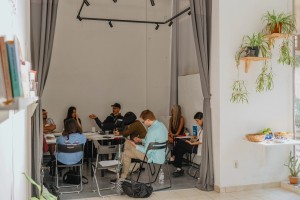
Co-creation through play: Exploring dynamic engagement in PMP Workshop Weeks
Co-creation—shared authorship and creative agency—lies at the heart of engaged cultural practice. Among the many tools available to artists, facilitators, visitors and participants, play stands out as a particularly dynamic and transformative approach. Drawing inspiration from Johan Huizinga’s Homo Ludens, which posits that play is a fundamental element of cultural creation, this article explores the role of playful methods as one of many approaches used during the Professional Media Presence (PMP) Workshop Weeks.
Play is more than just a technique; it is an invitation to rethink boundaries, experiment freely, and connect with others in unexpected ways. It offers a way of engaging that is both liberating and structured, fostering creativity and innovation in the process. By reflecting on the diverse methodologies employed in the PMP workshops and examining the impact of playful methods, this article highlights the transformative potential of play and its role in reshaping how we co-create, collaborate, and imagine new possibilities.
1. Why play? / Why this matters?
Grounded in Johan Huizinga’s Homo Ludens (1938), which argues that play is a fundamental cultural act, play in co-creation activates experiential learning, opens spaces for spontaneous interaction, and invites participants into creative discovery. Huizinga describes play as hybrids of ritual, competition, and improvisation. Playful tools—role play, game prompting, physical interaction—lower the barriers to sharing and make deep reflection possible.
Visitors are becoming participants through interactivity and playful methods.
Following outcomes align with Huizinga’s claim that play underpins culture, and co-creation amplifies it through shared agency.
- Inclusivity & accessibility: Play allows different entry points without prerequisite technical skill.
- Creative risk-taking: Making mistakes in play is okay, setting the ground for experimentation.
- Embodied learning: Through physical or virtual immersion, play engages mind and body.
- Co-creation as practice: Playmatic structures help participants collaboratively shape content.
These outcomes align with Huizinga’s claim that play underpins culture, and co-creation amplifies it through shared agency.
2. PMP Workshop Weeks overview
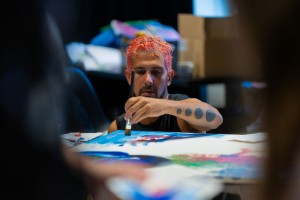
Between 2023 and 2025, PMP ran five on-site Workshop Weeks in Turku (Finland), Venice (Italy), Trnava (Slovakia), Barcelona (Spain) and Split (Croatia). Each week explored media content creation, digital presence, and professional identity, stylistically and thematically shaped by local partners’ expertise:
- Turku (2–6 Oct 2023): exploring Media and Art.
- Venice (8–12 Apr 2024): Focused on digital storytelling and media branding.
- Trnava (23–27 Sept 2024): Centred on social media, its readership, and critical media engagement.
- Barcelona (10–14 Mar 2025): Offered two tracks—XR/VR playful co-creation and AI-driven immersive narratives.
- Split (13 – 17 Oct 2025): Focused on media and professional identity
Workshops offered space for experimentation, collaboration, and mutual learning across crafts.
3. Some playful elements in Trnava
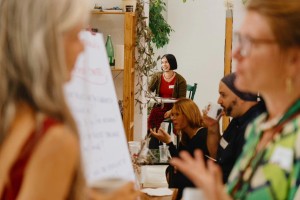
The Trnava program combined lectures on media literacy with interactive group tasks. Participants analyzed social media content and co-designed mini campaigns. Redirecting instructions softly—asking participants “what would a child do differently?” or “create tools on the fly”—produced hypothetical role plays. Though less high-tech, these playful elements provoked ideation. Create–perform–reflect cycles encouraged agility in thought, echoing Huizinga’s idea of voluntary, bounded play with rules yet open interpretation.
4. Some playful elements in Barcelona
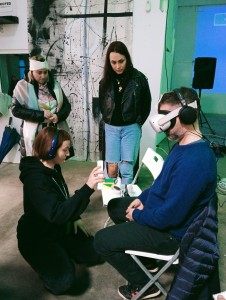
The Barcelona week immersed participants in play through VR (XR methods) and AI-augmented storytelling. The “Embodied Narratives” workshop employed BeAnotherLab’s “Machine To Be Another”: teams explored identities via body swap sensors, a strong creative play rooted in empathy and intersubjectivity.
A parallel “Virtual Environments” workshop harnessed spatial computing, AR/VR experiments—like the Rubber Hand illusion or navigation games—to provoke playfulness in immersive spaces.
These playful methods were not mere fun: they activated engagement, group trust, and unexpected connections. Co-creation became living play, not protocol, with participants designing, scripting, and simulating collaboratively. Final works were shown at the week’s close, demonstrating how play itself serves creation.
5. Some playful elements in Split
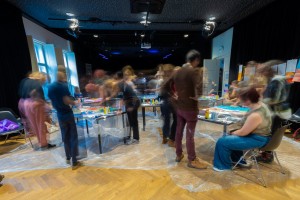
Artists explored themes such as online authenticity, artistic branding, and performative identity through interactive sessions. Playful and reflective exercises—ranging from collaborative nature walks in Marjan Park to humorous social media role-plays—helped participants experiment with new ways of representing themselves while maintaining authenticity.
The week concluded with a Speed Networking event, where participants met curators, producers, and fellow artists to discuss future collaborations. The atmosphere was marked by openness, creativity, and mutual support—embodying PMP’s vision of a transnational artistic community.
Conclusion
Play is a dynamic tool within co-creative practices, not a disruptive afterthought. Turning to the PMP workshop weeks, play provided energy, risk freedom, and deep engagement. Transparency about its varied presence—more visible in places, less in others—demonstrates PMP’s commitment to local contextuality and honesty. Coupled with Huizinga’s philosophy on play, these experiences highlight play’s role in longevity, collaboration, and creative innovation.
This reflection serves as both an analytical frame and an invitation: use this method consciously, but without obligation—adapt, experiment, co-create.
As the PMP project moves towards its final exhibitions in October 2026 and the publication of the Professional Media Practices for Artists toolkit, the experiences from all five workshop weeks—from Turku to Split—form a vibrant mosaic of creative collaboration. Each location brought its own local energy and cultural context, proving that co-creation through play might be a universal language in art and professional development alike.
References
HUIZINGA, Johan. Homo Ludens: A Study of the Play-Element in Culture. Boston: Beacon Press, 1955. 219 p.